Maktab One
School management SaaS for mid-tier private schools
What it is
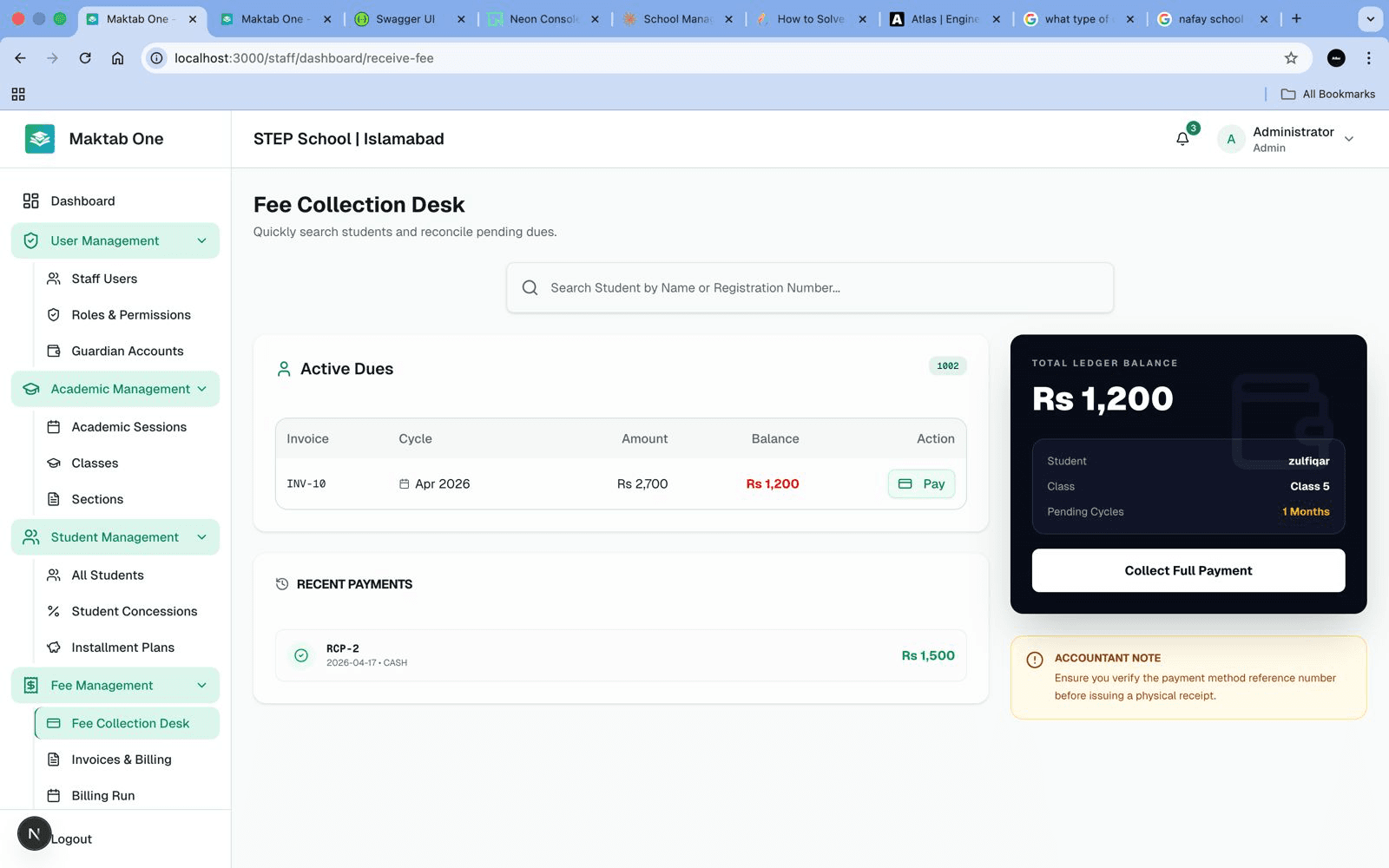
A cloud-based school management system that handles fee management, student records, expense tracking, and parent communication from a single dashboard.
Who it serves
Mid-tier private schools in developing markets that need affordable, reliable school management software without dedicated IT staff.
Business value
Reduces administrative overhead by 80%, eliminates fee tracking errors, and gives school owners real-time financial visibility across their institution.
Primary users
School administrators, accountants, teachers, and parents/guardians.
Category
SaaS Platform
Role
Full-Stack Engineer
Timeline
3 months
Status
Production
Team
Solo
Platform
Web
Industry
Education Technology
Frontend
Next.js
Mid-level private schools in Pakistan operate on thin margins and cannot afford enterprise systems like SAP or Oracle. They rely on paper ledgers for fee tracking, which causes errors, lost records, and hours of manual reconciliation each week. School owners have no real-time view of their financial health.
Configurable Fee Engine
Multi-tier fee structures with support for grade-based slabs, transport fees, late penalties, and scholarship discounts. Auto-calculates totals and prorates for mid-term admissions.
Multi-Role Portal
Role-specific dashboards for administrators, accountants, teachers, and parents. Each role sees exactly the data and actions they need, secured by hierarchical RBAC.
Automated Receipt Generation
One-click PDF receipt generation with school branding. Receipts are auto-numbered, stored permanently, and accessible to parents through the guardian portal.
Multi-Channel Notifications
Automated fee reminders via email and SMS. Payment confirmations are sent immediately. Configurable reminder schedules ensure parents never miss a due date.
Frontend
Backend
Database
Infrastructure
Tools & Services
A monolithic Express.js API serves the business logic layer, with Prisma ORM providing type-safe database access to a shared PostgreSQL schema. Tenant isolation is enforced through a middleware layer that injects school-scoped filters into every query. The Next.js frontend uses server-side rendering for initial page loads and TanStack Query for client-side caching.
Ensuring tenant A can never access tenant B's data in a shared database schema.
Built middleware that injects schoolId into every query automatically. Prisma middleware hooks validate the filter exists. Integration tests verify isolation at the CI level.
PDF receipt generation blocking API responses for 2-3 seconds per request.
Moved receipt generation to a background job queue. The API returns immediately with a job ID, a worker generates the PDF asynchronously, and the frontend polls for completion.
Aggregated fee reports scanning thousands of records, taking 3-5 seconds to complete.
Introduced materialized views that pre-compute daily fee summaries. Reports query the pre-computed view instead of raw ledger data, reducing query time to under 100ms.
Interested in building something similar?
I am always open to discussing new projects, technical challenges, and engineering opportunities.